Thursday, April 28, 2011

Photos from the Beach, Oudaya Neighborhood, and the Traditional Medina

Here are some photos from my most recent adventures around town in Rabat. It is truly beautiful and I am so glad to finally put pictures up to share with everyone. The beach is about a 20 minute walk from my house, and I pass through the Oudaya neighborhood on the way. The traditional medina, or market, is usually bustling with people and vendors, but at night is is quiet and I always feel less rushed. Enjoy!


Sunday, April 24, 2011

Moroccan-style Mock Wedding Ceremony

AMIDEAST-Rabat is hosting around 27 students from various American universities for their spring semester abroad program, and I was invited to the “mock wedding” a few weeks ago. The program organizes cultural events for the students so that they are able to sample various aspects of Moroccan culture during their time abroad. The experience was so fun and I now have a greater understanding of the work that goes into a Moroccan wedding.


Traditionally, Moroccan weddings take place over seven days with both sides of the family involved in preparing the food, buying seven different outfits for the bride and groom, and hosting family members from out of town. Nightly parties and feasting occur as family, friends, and neighbors gather to celebrate the beginning of the couple’s new life together. AMIDEAST organized a shortened version of the semester abroad students of one evening with musicians, food, dancing, and traditional singing. The students drew random names to determine members of the wedding party, and the day of the wedding the bride started getting ready hours before the rest of the guests.


My host mother graciously lent me her beautiful kaftan, traditional Moroccan dress, which she wore for the birth of her most recent grand-daughter. Kaftans are floor length dresses with long sleeves in beautiful colors and designs. The male version of the kaftan is called a djellaba (jell-ah-ba), and is a less flashy version of the kaftan. My dress was white with silver beading and embroidery detail, and my host mom even lent me matching shoes! I was so excited to wear it that night to the party, and to see the other female student’s kaftans as well.


We gathered in one of the classrooms at AMIDEAST for the event, and were greeted by Moroccan musicians dressed in traditional loose-fitting clothes. The singer started off the first song as the drummers and tambourine player followed suit. The loudest instrument was the set of castanet-like instruments made of iron that were played in quick jumpy rhythms. All of the musicians danced and sang as they played, moving around the room and catching the attention of the guests. Moroccan guests who entered the room began clapping to the familiar rhythms of wedding songs, and the Americans eventually joined in.

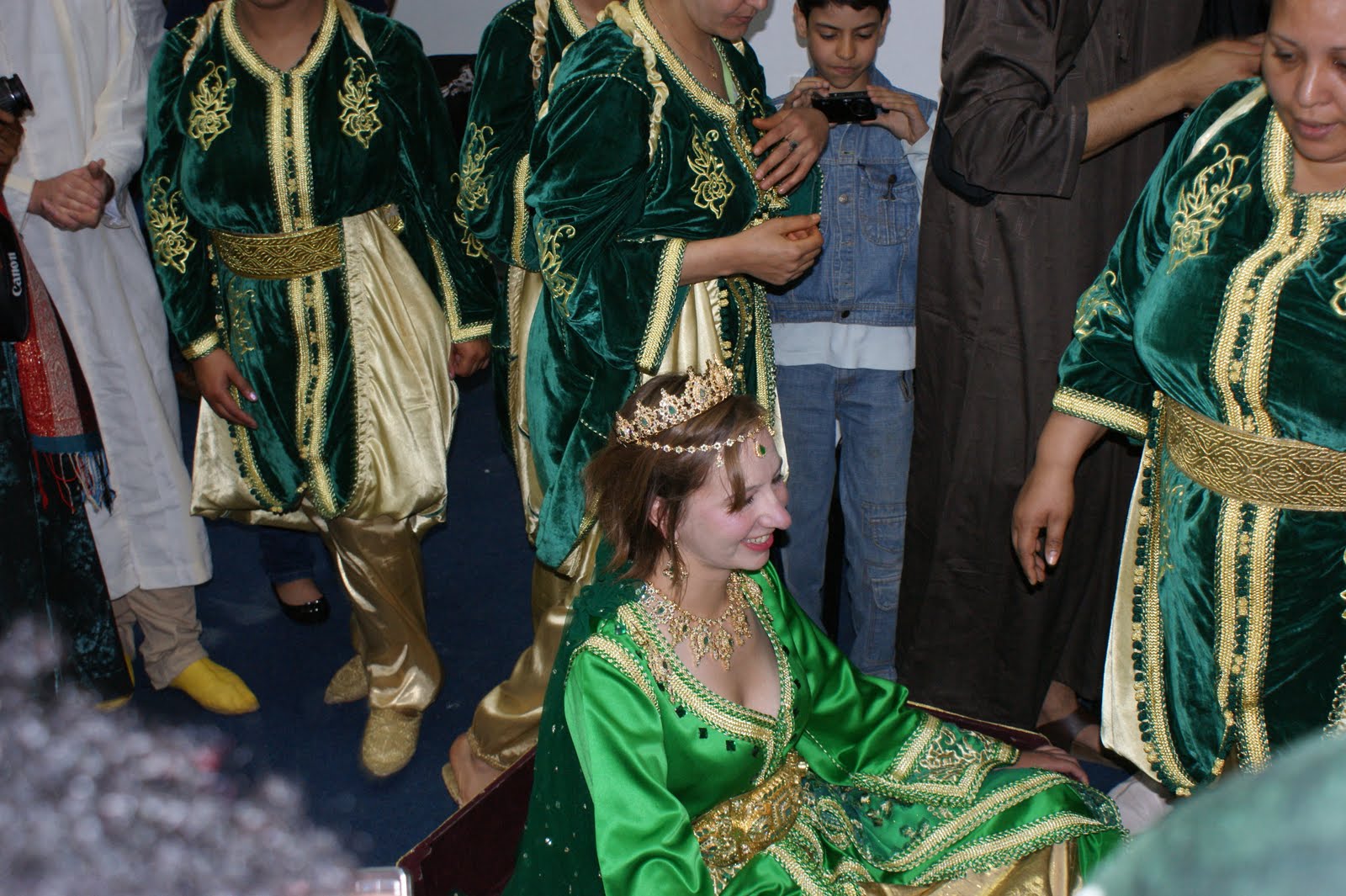
As the music continued and guests greeted and complimented each other on their “mock wedding” clothes, a female student ran down the hall squealing, “She’s coming everyone, she’s coming!” Well, this could only be one person…the bride. Everyone rushed to bring out their cameras in preparation for her grand entrance. As she walked down the hallway, the musicians changed the rhythm of their song to a heavier rhythmic process-like pace. The bride was accompanied by four female attendees dressed in green and gold robes with matching gold pants and slippers. They carried with them a gold padded platform attached to two long planks. As they entered the room, they lowered the platform, allowed her to step in and sit down, then hoisted the platform up on their shoulders and proceeded to parade her around the room high above the crowd. She looked absolutely stunning in her emerald green dress with gold beading and gold jewelry. Once the attendants reached the wedding couple’s table at the front of the room, the platform was lowered and the bride disappeared. When it was raised again, the groom had replaced the bride and a second processional began around the room with increased singing and clapping.


After the wedding processionals, tea and cakes were served and traditional henna was available for the female guests. Henna is a plant based product that temporarily dyes the skin, allowing the design to last for up to two weeks. The bride’s henna design was created by one of her attendants, and included gold glitter. Both her palm and the back of her hand were decorated, and traditionally the tops and bottoms of the feet are also decorated for Moroccan weddings.


After several group photos, the music and dancing continued until late in the night. It was a wonderful experience and I am sincerely glad that I attended. During the following week, everyone was wishing the “married couple” a happy life!


[photo credits to Doha Ait Ahmed of AMIDEAST-Rabat]

Sunday, April 3, 2011

Presentations in Casablanca, Reflections on American Higher Education, Finding my Passion


The second week of my internship I went to Casablanca for my first college forum at a private high school. Casablanca, or "Casa" as they call it here, is an enormous city of around seven million people. It is very western in its design and appearance with towering sky scrapers, passive aggressive taxis, and crowds of people everywhere. While Rabat is the political capitol, Casa has developed as the economic and business capitol thanks to the large port.


This port was the first sight (and smell for that matter) that I experienced upon arriving in Casa. I took a combination of train + taxi + interesting directions to finally arrive at the El-Jabr school in time for my tabling session. After arranging the table with my "Education USA" and Amideast materials, I received many questions from interested parents and students on studying in the US: How much does it cost? What is the best school? Can I get a scholarship for sports? What is a good SAT score? Which is better, a private or public university? What kind of visa do I have to apply for?


These and many more questions floated around my table that morning as did my best to provide answers in French. The visitors were very patient with my language skills, which made me feel much more confident about the presentation that I was scheduled to give that afternoon. There were 45 students crowded into the room, and for the first time during my internship experience I actually felt like an educator. I knew that these students were attending my session because they wanted to study in the US, and I had the information to help them achieve that dream. The presentation went well, and my assistant was able to clarify for the students the differences between the American and Moroccan education systems. She assisted me in answering questions after the presentation, but made sure that I had the main floor for the main portion. I was really proud of myself for jumping in and giving it my best.


After the presentation, I visited the Amideast office in Casa and met a few of the teachers who were working that afternoon. It is always interesting to see different branches of the same organization. The staff was friendly and gave me a tour of the offices and classrooms, which are labeled with American states (i.e. the "Washington" Room, the "Florida" Room) and decorated with coordinating posters from the state. I thought it was clever and cute. I was bummed to see that there was no "Oregon" room, as California and New York seem to be more popular and recognizable to international students. That's ok, I see it as my job to represent my state and teach my friends and colleagues at the Northwest US in general. After thanking the office staff and my assistant, I took a cab back to the station and caught the evening train home. It was an exciting day with lots of new experiences to build upon for the future.


Throughout my time abroad, I have developed an emotional readiness scale for myself to determine if I am prepared to experience something new. I call it having a "brave day" in which I do something that is entirely new and different from my previous experiences. The day in Casa was definitely a brave day for me.


This week I traveled to Casa again for another presentation on Graduate and MBA programs at the Ecole Nationale de Commerce et du Gestion (National School of Business and Commerce). Navigating around the city was slightly easier this time, and I was surprised to see the great turnout of 165 students for my presentation. Representatives from the US Consulate and US Embassy gave a presentation directly following on obtaining a visa for study and travel in the US, which was great for the students. I have found it very inspiring to see so many students who are taking steps in preparing to study in the US. Before going abroad, I was not aware of the popularity and prestige of the American higher education system. After interning with Amideast for several months, I have learned so much about my own education system and the systems in Morocco and Tunisia. I am proud to be a citizen of a country that many foreigners seek to improve their education and skills in order to advance their own countries upon return.


If I have learned anything during this internship experience, it is that I have developed a passion for education, specifically for helping students obtain opportunities to learn and grow as individuals in their own country and abroad. I sincerely hope that this passion and experience will guide me onto the next point in my life, wherever that may be. For now, I am taking the experiences one day at a time and enjoying what life brings me here in Morocco.


Thanks to my contacts at Amideast Casa, I was put in touch with a wonderful English couple who gave me a tour of the downtown area and invited me back to their house for dinner. After a lovely evening with fascinating conversation and more than one "linguistic misunderstanding" between our different dialects of English, I reminded myself that everything really does happen for a reason and sometimes you just have to be open to the unexpected things in life.

Sunday, March 27, 2011

Arrival to Morocco, First impressions of Rabat


Morocco!

I have now been living in Morocco for a month and am settling in quite nicely. On my very first day arriving in Casablanca I was met at the airport by two Amideast representatives holding a hand-written sign that read "Amideast Intern". I instantly felt welcomed into the country. I was very excited to meet them and get to know basics on Moroccan culture during our one hour drive north to the capitol city of Rabat. I met the Amideast host family coordinator as soon as we arrived into the city, and then we drove to my host family's house. They live in an apartment in Rabat Centreville, the main downtown area of the city. I can see the walls of the old medina, or historic neighborhood, and a large public park from the third-floor balcony. It is a 15 minute walk to the beach, and a simple 10 minute bus ride to the more lively part of downtown with cafes and fancy shops. There is always lots of traffic outside our apartment building with the daily market and main busroute nearby, which makes for an exciting place to people watch.


In my host family I have a host mom who is a retired custom's officer and a host sister studying finance at the local university. She is in her early 20's and goes out with her girlfriends often to cafes and to the medina to look for fun things to buy. It has been great to hang with her and meet her friends. They speak French and Arabic at home, and my host sister has an intermediate level of English to help me out if I get stuck somewhere. Each day I take the city bus to work at Amideast, where I am working as the Educational Advising Intern. Although I am interning for the same organization, my tasks here in Rabat are more focused towards educational outreach and maintaining our resources in the Advising Center. When students come to the center with questions on studying in the US, taking the TOEFL exam, or getting a scholarship, they come to me. I am able to advise them in English, and am also slowly working my way into advising in French as well. I make mistakes of course, but generally the students understand my main ideas and are happy to receive the information. I also have the opportunity to travel as an Amideast representative to college forums in the region, which has been a fantastic experience.


Rabat is an interesting city to live in, and I am making the most of my evenings and weekends by venturing out and exploring new places. I love the mix of French architecture and traditional Islamic architecture than can be found sometimes in the same neighborhood. The mosaic designs are incredibly beautiful, and can be found in many places of the home. Moroccan textiles reflect a similiar busy pattern with wonderfully vivid colors. My favorite part of the city so far has been the corner shop juice stands where you can get a glass of fresh squeezed orange juice for about $.40.


Again, great people watching and friendly guys who run the shop. Before coming to Morocco, I honestly did not know much about this North African country. I have done some research since I have arrived and now have a better understanding of the political system and the country's foreign affairs. I am learning more and more about the culture every day through meeting new friends and making new connections. One thing that is important to remember is that Morocco is a safe place and that there are no talks of "revolution" here. Life is good and I am enjoying every moment of it.

Monday, March 7, 2011

Christmas in Sicily, January's Jasmine Revolution, February in Sicily and Germany

Hello friends and family! Apologies for my long and unintended hiatus from my blog. I will make a much more significant effort in these next few months to post more entries and to keep everyone more informed on my travels and experiences abroad.

So . . . quick recap from the last few months:

In December I finished up the first half of my internship at Amideast-Tunis. It was a very busy time with post-IEW plans and preparing for the deadline of all the student applications for the Tomorrow's Leaders program. Everyday was a new project and a chance for me to really experience the behind-the-scenes work of an exchange program. My work was preparing the selection process and beginning to review applications as they came into the office. I also proctored another SAT early in the month, which gave me some extra spending money for Christmas presents.

I am fortunate enough to have friends all over the world and I do my best to keep in touch with people throughout the year. Friends living near Catania, Sicily invited me to their house for the holidays, and I gladly accepted. We toured around the region visiting small traditional Sicilian villages and the big city of Catania to experience a Mediterranean Christmas complete with cappucinno and cannolis. It was fantastic to walk on the beach and hike up the nearby cliffs on Christmas morning with only a light jacket while enjoying the sunshine and crisp sea breeze. Christmas dinner was a wonderful experience with an all out holiday-style dinner and friends from all over the region. I ate very well that night and enjoyed the company of military friends who had traveled all over the world thanks to their posts and personal interests. It is always great to mingle and to hear other's stories about their adventures abroad.

As always, it was difficult to leave my much needed vacation in Sicily to return to Tunis for work. I said goodbye to my friends and boarded the plane bound once again for Africa. New Year's eve was spent with Canadian and Italian friends in Tunis as we watched the satellite broadcast of countries all over the world ringing in the new year. We ate well and toasted to the upcoming year filled with new friends and new adventures.

Little did I know that when I returned to work at Amideast in January, Tunisia was already experiencing great change that would start a revolution of massive proportions. I had heard of some unrest in the south of the country, and that a young man had drenched himself in gasoline and burned himself in response to the lack of opportunity for educated youth in Tunisia. It was very difficult to find any news of the event in the local press or on the evening television reports due to Tunisia's strict censorship laws. The secret police are in fact a very big deal in Tunisia and the citizens take care to not discuss politics or their opinions on the president Ben Ali. As the days progressed, I heard more rumblings about the situation getting worse, and that the frustrations over the lack of government support were not only in the south but were a general national resentment. I was able to find a few articles on France 24, the NYtimes, and BBC online which became my primary resources for the next few months. Rumors of riots growing larger convinced the director of Amideast to close down the school for a few days until things settled down, and so the revolution began in Tunis.

Here is a Times Magazine article with more details on the revolution:
http://www.time.com/time/magazine/article/0,9171,2043331,00.html

I must say that I have never actually experienced a revolution from within the country, and it was so powerful to see the spirit of the Tunisian youth challenging their oppressive government by telling them "you are not doing enough for us, so we want change". Almost half of Tunisia's population are youth ages 16 - 25, many of whom have college degrees with no opportunity for work. Many of these students have become disenchanted with the system that promised a good education leading to a good job, and consequently have no option to properly support their families. I was so proud of my Tunisian friends who joined their fellow countrymen on the days of the protests to support the change that they wished to see in their own country. President Ben Ali was very stubborn with his people and did not give in easily, but eventually the pressure became too much.

During the day the military protected the government buildings and establishments, but at night the city of Tunis turned volatile. A curfew was imposed from 5:00 pm to 6:00 am in order to prevent more protests on the streets. I was instructed by my colleagues to stay indoors and not venture out at all because the police had orders to arrest anyone who looked suspicious or anyone who was gathering in groups larger than three. There were snipers on the roofs near my building, and army tanks driving in each day to protect the buildings from looters. At times it was reassuring to have so much protection around the building that I was living in, but at the same time I knew that the tanks were close because there was a chance that we would actually see some of the violence. I made sure to stay in my apartment with my friends and not go outside during the day unless it was absolutely necessary. We stockpiled as much food as we could and began to wait for things to get better in Tunis.

Each morning, I would log onto my computer and check facebook to see what had happened the night before. My Tunisian friends would post status updates, photos, and even short videos taken from their cell phones to show what was really happening. By the afternoon the videos would be taken down and oftentimes the photos would be blocked by the government. It was a pretty strange time for everyone in the country. As the portests became more violent, the death tolls started to rise and we knew that something big was going to happen. Finally President Ben Ali came on the news and said that he was stepping down as president of Tunisa. We couldn't believe it. Had this really happened? The biggest question that was on my mind was, "now what?". None of the youth who were less than 25 years old had ever voted or witnessed a real presidential campaign, and policital activism was something that only happened in secret with individuals who held strong views due to all of the censorship and press restrictions. "What is going to happen now?" I asked myself this question that night, and I am still asking it now.

Ben Ali had at least 2500 personal body guards on his payroll that acted as secret police to inform him on what was happening in his country throughout his 23 year presidency. When he fled the country he essentially told his body guards to destroy everything of value so that Tunisians could not enjoy what he had created for them. Talk about a "god-complex", right?

The apartment complex that I was staying in at the time had shops and boutiques on the first level of the building. Within days of Ben Ali leaving Tunisia, everything underneath my apartment was looted by gangs of pro-government supporters. I remember looking out my window one afternoon and seeing hundreds of people running down the hill and into the courtyard with pipes, bats, and fence posts ready to destroy the shops. I called my roommates together and we shut all the curtains and gathered in the living room together away from the windows. The sounds of yelling and smashing glass echoed up the stairwell, and I had never been so scared that our apartment would be broken into. We locked the door and braced it with a heavy cabinet and prayed that no one would venture up the stairwell. It was a very scary feeling knowing that we lived on the fourth floor and the only safe way out was through the front door. That hour is potentially the longest one that I have experienced in my life thus far.

When we heard the sound of large trucks driving down the street, we ventured toward the window to move the curtain aside. The Tunisian army haad finally showed up with more tanks and soldiers to chase away the gangs, but not before they looted everything from the shops below us and threw most of it into the street. When things had quited down outside, we ventured out onto the balcony to look down at the debris. Shop owners were arriving to check their their wares, and were sadly sweeping up the broken glass and taking what was left from the looting to better storage facilities. It was frusterating to know that these were Tunisians doing this to their own people, and that it was simply creating more problems for those who were just trying to be safe and follow the rules. Those who were loyal to Ben Ali were not going to give in easily.

The frightening part was that many of these body guards were also policemen, so the people found that they could not trust the organizations that were supposed to protect them. The army, on the other hand, remained in good graces with the Tunisian people throughout the revolution because they would not fire on innnocent protestors. In a sense, the army was called in to protect the citizens from the police and from the violent protestors.

After more than a week of protests, violence, and living under a curfew while watching the news indoors all day, my university program decided that it would be best for me to leave the country for a while until things settled down. They arranged a flight for me the enxt morning that would take me to Italy, and then onto Sicily to stay with the same friends that I had spent Christmas with just a few weeks prior. I packed what little I had with me that night and caught a cab the next morning to the airport. All foreign bank accounts had been frozen at that point to prevent the Ben Ali family from withdrawing their savings and departing the country as well. I waited in line for what seemed like hours due to all the tourists who had unfortunately been cooped up in their hotel rooms for their vacation. The flight was nice and my friends were more than happy to receive me as a "refugee" from North Africa.

It was comforting to finally be staying in a place where I felt safe. I no longer woke up at night to the sounds of gunfire outside or smashing glass, and finally felt at ease to be outside of my residence without hearing the drone of helicopters hovering overhead. The first week that I was in Sicily the tv was my main source of news to follow everything back in Tunis. I was able to access youtube for the first time in months, and Al-Jazeera in English, which allowed me to follow the events in real time. I spent five long weeks in Sicily and one week in Germany waiting for things to calm down in Tunisia so that I could return to continue my internship. At times, I wresteled with feelings of guilt for leaving my friends and my work behind, but was reminded that I had to follow my university program's guidelines.

As with all revolutions, there is no designated timeline for things to work themselves out, as it is oftentimes a people's movement that requires time effort to build a solid foundation. I knew that this was a project for Tunisians to do for themselves, and it was not a situation where I could necessarily help. I am truly fortunate to have friends in this part of the world and to have been welcomed into their homes during my time of, shall we say, "displacement" until I found a new place to go.

My university internship program advisors were fantastic in working with me throughout the time that I was gone to figure out what my next move would be. Tunisia was no longer an option, at least for the next few months. Finally, Morocco arose as a viable option because they had an Amideast office in the capitol city of Rabat. I happily accepted the offer, and made arrangements to start my new internship on March 1. Five weeks in Sicily and one week in Germany gave me a wonderful chance to relax and to process everything that had happened in Tunis, and also to prepare for future plans. I greatly enjoyed my time spent with friends and the trips that we were able to take together.

So now, as I prepare to start a new adventure in a new country, I will take with me the things that I have learned and create whole new experience.

On to Morocco!

Wednesday, December 8, 2010

Photos from around Tunis

Here are some photos from the beginning of my internship experience in Tunisia as I was beginning my work at Amideast and gettling settled into Tunisian life.


Day #1 of my internship. So young a hopeful!


I love putting quotes up around my work station to remind me of my purpose and to motivate me when I am feeling pressure or stress from my projects. Here are two quotes that I have at my desk that have really inspired me during these last three months.


The plaque for my particular department, Advising and Testing. The entrance courtyard is just on the otherside of these blue doors, and the Jasmine plant that you see growing in the corner cascades over the other side, filling the entrance with the beautiful scent of Jasmine. I still smile every day that I walk through the courtyard.


This is the best smoothie drink in all of Tunis. It is made a little "hole in the wall" (sometimes, in the literal sense as well) shops. Fresh fruit, yogurt, and nuts are taken from the stand and put into a food processor right in front of you to become this delicious thick smoothie. To top off the presentation, it is topped with shaved coconut, ground almond powder, whole hazelnuts, and a drizzle of honey. Best afternoon snack ever!


In Tunisia I have found the stray pet population to be much more common than in the US. Stray cats are found on nearly every street corner, and can really pull at your heartstrings with their haunting eyes and malnurished bodies. Thank goodness I am immune to their pull, as I do not harbour feelings of feline appreciation. However, there are select moments where I do enjoy their presence on my walk through town, as shown in this photo.


Here is the tower of the Zaitouna Mosque near the old medina market in the center of downtown Tunis. I have fallen in love with Arab architecture and continually find beatuiful buildings, columns, and doorways all around Tunisia.


More photos to come soon! Thanks again for all the support and encouragement!

IEW and Photos

Now for some updates! IEW went very well, and I am quite pleased with the outcome and the spirit of teamwork and support as the deadlines approached and the mild chaos of event planning took over. The events that were hosted at Amideast this year brought in record attendance at the American Corner, the international lounge/library, and we are now very busy with advising and directing students on their options for using the services at our organization. I say it was a success!

Last week the new director of my IE3 internship program came to Tunisia to make a site visit, so the timing was perfect for him to see what I was able to accomplish during my short time with the organization. My supervisors were very pleased, and are making plans for my work to carry over to the next intern who will arrive the in the spring, in-sha'allah (God willing)!

I have finally figured out how to get the photos off of my Blackberry phone, which has served as my camera for the duration of my trip thus far. Here are some photos from the week:
The image at the beginning of this entry was the banner that was hung outside the Amideast Annix building that housed the American Corner. The text translates to "Open House Days", and was a great addition to the advertisement that we placed in the local newspapers and on Facebook.
Here are a few from Thursday, one of my favorite days during the week, when we presented on the story of Thanksgiving and had the students do puzzles and quizzes for candy prizes. The quiz was really hard . . . I didn't even know the answers to a lot of the more difficult questions. Maybe I need to brush up on my American history while I am here in Tunisia . . .
Friday's panel presentation, the event that I was looking the most forward to during the entire week, experienced a small hiccup prior to the start of the event when two of the panelists were not able to come at the last minute. As I frantically attempted to call my backup panelists, the facilitator of the event, Lee Jennings (also the director of Amideast), suggested that I fill in for the missing people because I fit the criteria and had the experience to present on the topic of international experience. I was very flattered and honored that my director would ask me to be part of the panel, so I happily obliged. The evening turned out to be very smooth, insightful, and allowed students to really see the impact of a study abroad experience in the short-term and long-term possibilities.
Here's to more successful events in the future!

Friday, November 19, 2010

International Education Week

During my time at the University of Oregon I worked as the Program Manager for an international lounge called the Mills International Center. I absolutely loved my job, the staff members, and the vast networking that I was able to do during my two years at the Mills Center. The experience that I gained from working with an amazing staff and team really set me up well for the work that I am doing here at Amideast, and has helped ease the transition as I began to receive more familiar tasks in coordination with the needs of Amideast.

I was overjoyed when my supervisor began to talk about International Edcuation Week and asked if I would like to take on this large project. At the Mills Center I successfully planned the week-long series of events two years in a row with the help of an amazing staff that really made the week a fantastic experience. Events ranged from informational and academic presentations to cultural discussions, fine arts displays, and informal concerts featuring music and dance from the geographic regional theme.

Here's a quote from the International Education Week (IEW) website http://iew.state.gov/index.cfm :

"International Education Week is an opportunity to celebrate the benefits of international education and exchange worldwide. This joint initiative of the U.S. Department of State and the U.S. Department of Education is part of our efforts to promote programs that prepare Americans for a global environment and attract future leaders from abroad to study, learn, and exchange experiences in the United States."

This totally fits with Amideast's motto, so I was thrilled to work on a project that was familiar and challenging at the same time. The catch with the request was I had only three weeks to plan the events, and the only records for reference were from last year's activities. So, I dove right in to the process of planning the theme for the week, structuring the events with presentations and fun activities, reserving the rooms throughout the Amideast complex, ordering advertising space in local newspapers, and working with Amideast professional staff to help me navigate the logistics of really getting the word out on these events. I have learned that an event planner is never alone is his/her work because there are always people and resources to assist in the process.

Normally, International Education Week (IEW) happens this year from 15 - 19, but in Tunisia the academic break falls exactly during this week, so we pushed the events back a week. Afterall, it is the students that we want to target for our events, so we have got to make sure that they are going to be available to attend. Each day is broken up by a different theme related to the services offered through Amideast and the programs that we encourage students to take advantage of during their high school and college years. Here is the schedule of events that will take place next week at Amideast:

International Education Week 2010

Monday Nov 22 – Exchange Program Day

4:00 – 5:00: Presentation of study abroad programs available to Tunisian high school and university students for study in the United States
5:00 – 6:00: Exchange Program Alumni Social Hour (meet students who participated in these very programs)

Tuesday Nov 23 – American University Admissions Day

3:00 – 4:00: Presentation on three branches of university-level study in Humanities, Engineering, and Business (Amideast Villa)
4:00 – 5:00: Workshop on How to Write a College-level Essay and Statement of Purpose
5:00 – 6:00: Presentation by the US Embassy on the Process of Obtaining a US Visa for study in the US

Mecredi Nov 24 – Extracurricular Activities Day

4:00 – 5:30: Presentation on extra curricular activities that contribute to a diverse experience at an American University (Topics include student groups
(Fraternities, Sororities, Campus Government), clubs for international students, Music and Dance Groups, and Toastmasters (public speaking))
6:00 – 8:00: Film screening followed by discussion

Thursday Nov 25 – Thanksgiving Day

4:00 – 4:45: Presentation on the history of Thanksgiving and the modern day traditions in America
4:45 – 5:30: Interactive Thanksgiving Day quiz

Friday Nov 26 – Career Day

3:00 – 4:00: Workshop on How to Compose an American CV/resume and the Process of Obtaining Letters of Recommendation
4:00 – 5:00: Interactive Session on Professional Job Interviews
5:30 – 7:30: Panel Presentation “The Effect of a Study Abroad Experience on a Professional Career”, bi-lingual in English and French (Amideast Main building)

I am very excited to see how everything turns out and to see a project from start to finish here at Amideast. The event that I am most eager to attend and experience is the bi-lingual presentation on Friday. My vision was a presentation for both students and their parents that shows generationally the impact of a study abroad experience on an individual's personal and professional life, and ultimately motivate the student to participate in a study abroad experience. Its going to be a long week, but I am looking forward to seeing the results of my work over these past few weeks.

Eid Mabrouk, finding a Tunisian host family, slaughtering a ram in the process

Eid al-Kebir with Rania's family

I was invited to my friend Rania's house for the feast of Eid al-Kabir, which I gladly accepted as part of my promise to myself to always jump at participating in any family functions.

During this feast that happens 70 days after Ramadan, Muslims remember the story of the willingness of the prophet Abraham to sacrifice his son Isaac (Ishmael) to prove his obediance to God. As Abraham prepared to complete the sacrifice, God sent an angel to stop him and instead replace his son Isaac with a ram. It is for this reason that lamb is eaten for the feast of Eid. There is also a general sense of goodwill towards others as the meat is shared with the poor and those who have no families with whom to celebrate.

During the taxi ride to Rania's neighborhood, she chided to me that her younger sisters (13 and 19) were so excited to have a "real American" over at their house for Eid. They were amazed and delighted that I spoke French AND was learning Arabic. After meeting three sets of neighbors along the way who had heard about the "little American" coming to visit, I finally arrived at Rania's house and was warmly welcomed by the family. I brought gifts of Stash Tea (packaged in my very own Portland, OR) and a 60-piece puzzle of the United States for the family. Both were big hits. The girls presented me with lovely gifts of traditional Tunisian pottery, a beautiful scarf with traditional designs, and a wall hanging with a colorful hand-sewn floral pattern that the older sister had worked on all week. Each gift was individually wrapped in Micky Mouse wrapping paper. Nice touch. I truly felt like a special guest in their home from the moment I arrived.

When I entered the family's carport, I looked over to see a very shy ram tied to a post. Although I wanted to pet him I knew that his fate would be arriving soon, so it was probably best to not become attached. The daughters asked if I was going to watch their father slaughter the ram and I answered, "Of course! I want to be part of all the work today". Rainia told me that she was surprised because many Americans that she had met didn't even like the idea of seeing fish with their heads attached in a restaurant, so she assumed that I would not want to watch this particular part of the event. Well, I would like to think that I am eager and willing to experience new things every day, especially while here in Tunisa.

Before the father slaughtered the ram in the carport, he cleaned the blade and asked for God's blessing not only on the meal that was about to be prepared, but also that it may nourish all who take part in the preparing and consuming of the meat. Although it was a little difficult for me to watch, I was very impressed with the matter-of-fact attitude of the family that only comes from familiarity with the process of preparing and consuming meat. The mother explained to me that every part of the animal would be used in one form or another. All members of the family were present to help clean the animal, skin it, and begin preparing for the meal together, and I was happy to help out in any way possible. The mother was very happy to have an extra person around who wanted to learn everything about the process. I decided to help her with cleaning the organs, stomach, and small intestines of the ram since the girls expressed NO interest in this task. Hey, someone has got to do it, and I learned a lot of new vocabulary words in the process so I think everything worked out in the end.

After more than three hours of cleaning, grilling, and simmering we all sat down to the table in their small living room to share our first course together. There was so much work to be done during the day that we broke it up by smaller meals. The first was chunks of lamb that had been rubbed with rosemary and herbs from the family's garden, salata mishweeyah (a mix of pounded grilled peppers, onions, tomatoes, garlic, and olive oil) and h'rooz (a spicy red pepper paste mixed with olive oil). All of this topped with a great basket of french bread made for a fantastic meal. The sounds of hungry people eating food that is fresh and made with love is the best sound in the whole world.

After this first course, we cleaned up the car port, cleaned the kitchen, and sat down to watch some TV together. I do not have TV at my apartment in Tunis, so I have not seen the ads for the special tv programs that were made especially for Eid when families have time to spend together. We watched a Turkish sitcom that was dubbed in Arabic with French subtitles. Just another example that globalization is always at work, my friends. The daughters had so much fun asking me to repeat words in Arabic, especially the ones that were more difficult to pronounce. They would giggle and ask me, "muara-thahneeya, Addree-ane!" (Say it again, Adriane!)

As the night progressed, I began to think about heading home and wondered if there would be any taxis or buses available. When I finally asked, my host mom told me that there would not be many left, and offered to make up a bed for me so I could spend the night. I totally took the offer and stayed up late with Rania talking about traveling, languages, family, love, and dreams for the future. All in English and French. It was wonderful, and really showed me a new side of Tunisian society that I have not experienced until now. This was the "warmth" and "welcome" that the guidebooks and websites had been talking about for so long. This was what I have been missing as I walk through the crowded city streets and try to ignore the stares and unfriendly attitudes on the metro. I finally felt more comfortable with the idea that I actually live in Tunisia now. I live and work in Tunisia.

That night I dreamed in Arabic for the first time since I arrived here. Although I do not remember much about the dream as I write this entry, I do remember waking up in the morning and easily transitioning into Arabic from English. That was a really good feeling. My host mother made us a late breakfast and we lounged around the house for the morning, re-doing the United States puzzle a few times with more rounds of questions for me about the US. I was happy to talk about my country, and once again learned new vocabulary in the process.

That afternoon when I finally left my friend's house I felt more solid, as if I had established new roots in Tunisia. I was invited back for a weekend in December, and plan to make the most of my time with Rania and her family. As we walked to the main street together, I noticed that we were walking very close to each other and talking as if we were dear friends. It was very comfortable, and I consider myself quite lucky to have been given the opportunity to spend time with her family during this celebration. The gifts from the family and the containers of leftovers in the fridge are all reminders to me of their incredible generosity.

Sunday, October 31, 2010

Carthage and Sidi Bou Said

Last weekend I was able to check one site off of my personal list of "Things to do while in Tunisia": Carthage!

The ruins of the ancient city of Carthage are, in fact, a suburb of the sprawling city of Tunis. This made it convenient because I was able to hop in a taxi cab and twenty minutes late was standing in front of the tour buses waiting to enter the city of ruins. Cool fact: The city of Carthage is known as a UNESCO World Heritage Site, which makes it protected and easily accessible to tourists. I was finally able to be a tourist today, so my American companions didn't roll their eyes at me in embarrassment as I captured our experiences with my camera through many pictues. There are times when one must take a "mental picture" in order to remember it in the heart, but there are other times when the sheer magnitude of the scenery mustbe captured on film for future reflection.

A little history first. Carthage, pronounced "kar-TAJ" by Arabic, French and other non-English speakers, was once the center of the ancient world. The first civilization that developed within the area are referred to as "Punic" (Phoenician, or Carthaginian). According to Roman legend, the city was founded by Phoenician colonists from the city of Tyre under the command of Elissa, or Queen Dido, as referenced in Virgil's epic poem "The Aeneid". Overlooking the Mediterranean Sea, the city of Carthage proved to be an advantagous position to control the trading routes and military expansion, which led to many conflicts between the Romans, Greeks, and Phoenicians over possession of the city. After several battles back and forth between the Romans and Phoenicians for supremecy, the Romans attacked Carthage and decimated the entire city. Houses were burned, buildings crumbled, and civilians were either killed or taken as slaves. All that remains now is the ruins of a once great city that was ruled by a once great civilization.

We visited the Antonine Baths near the sea and the ruins of several tombs and prayer sites. It was an amazing feeling walking amongst the ruins knowing that these fantastic events occured upon the same stone paths that I was walking on. The small scale model reconstructions created by archeaologists who were working on a dig site near the ruins gave me an idea of the vast expansion of the city and the fortification that once protected it's inhabitants from harm. Apparently it was not enough against the Roman army.

For more information on Carthage, visit:
http://en.wikipedia.org/wiki/Carthage

After Carthage we visited the chic coastal town of Sidi Bou Said for a tour of the town and to enjoy the sunset over the Meditteranean. We walked up cobblestone paths through markets to the section of town that overlooked the sea for the best view. The area really reminded me of what I have always pictured Greece to look like with the white buildings and blue shutters and palm trees. The view from our cafe balcony was breathtaking, and I enjoyed my hot mint tea very much as the sea breeze cooled the evening air. I couldn't help but smile as I enjoyed the beautiful scenery and the company of fellow Americans.

JCI Event with Special VIP Privilges

Apologies for the lack of entries lately. After being sick, I recovered and life has been a whirlwind ever since. Let's start wher I left off and catch up from there . . .

At the request of the director of Amideast, I attended an event at the Minicple Theater in downtown Tunis called the FYOTD (translated as the five opportunistic disabled youth of Tunisia) sponsored by JCI (Junior Chamber International). My task was to meet and mingle with the people at the event and find out if any of the nominees were of high school age, and if they would be interested in applying to study abroad in the US as part of the YES program through Amideast. I was happy to oblige . . . requesting that I attend a fancy event and mingle with motivated youth and professionals who are interested in bringing about change in the world? Ok, I'm in!

A little background first: JCI is a world-wide organization that provides development opportunities to young people to encourage activisim and positive change. I mentioned that I was attending the FYOTD event to my supervisor, and she suggested that I meet up with her neighbor later that day who was also attending the event. I was lucky enough to spend the afternoon with her and learn about her fulbright experience teaching Arabic while studying english at a university in the American South. As I am writing this entry I do not recall which southern university she taught at, so it shall remain a mystery.

The FYOTD ceremony was held at the beautiful Municiple Theater in downtown Tunis. It was built at the turn of the 20th century in classic French architecture style, and the balcony looks out over the famous bustling Avenue Habib Bourguiba. I was also lucky enough that my Tunisian companion's cousin happened to be one of the organizers of the event, so we were ushered around to the back of the theatre in order to enter through a seperate door. After coming up a sindy staircase,we were led to a VIP seating area with nice red velvet chairs. I was so surprised to have such fancy treatment, and repeatedly thanked everyone who worked the VIP area that night. We were given bundles of jasmine flowers and refreshments as part of the event as well. What can I say, it's good to have connections!

The ceremony honored the five most outstanding disabled youth in Tunisia in select categories of higher education, athletics, fine arts, computer science and communication, and traditional arts. Between each nominee, a famour singer, musician, or poet would perform his/her latest work for the audience as a form of support for the youth and to keep the event young and hip. These local artists added an interesting flavor to the overal atmophere of the event. A short introductory video was made in Arabic about each student explaining their disability and the reason for their nomination. I attempted to gleen as much information as I could from the videos and context, but was grateful to have a Tunisian companion for the evening. After the video, each student was asked to come up on stage in order to be presented with an award, and asked to speak a little about their plans for the future in regards to their specific field.

Nominees included a master's student in a wheel chair, a foot painter (an artist who paints with his/her feet due to lack of motor control in the arms), an olympic runner who is blind, a computer science engineer with severe speech disabilities, and a traditional textile and pottery artist who is blind. Each student was unique in their own pursuit of their passions, and from what I understood from their personal statements, each had overcome difficulties to establish themselves as "normal" in society.

One of the most touching points was when the wife of the computer software engineer shared the story of how they met and fell in love. They both worked for the same company and had worked together on several projects. She was inspired by his kindness and generosity to those around him, despite people not always providing the same respect and dignity when they initially interacted with him. In spite of this adversary, "he walks the walk and talks the talk", she said, "and for that he is better than any 'normal' person I know and an inspiration for everyone". His story was really quite amazing, and he looked so humble as he accepted the award, and so proud as he turned to his wife and smiled at her as she squeezed his hand. Ah, sooooo wonderful!

Tuesday, October 12, 2010

Alcohol in Islam

Correction from a recent post: the production and consumption of alcohol is generally forbidden in Islam, but as we see in Tunisia, the rules are a little looser. In my sick state my editing skills were apparently not up to par. Sorry for any confusion!

Monday, October 11, 2010

Bar with Americans, SAT's, Sick all weekend

Alrighty, so for my first actual free weekend in Tunis I had these grand plans to go out with my new American English teacher friends, discover more parts of the sprawling city of Tunis, and eat some really good food. Well, I managed to do about half of the above...the first part of the weekend was fun and exciting at least.

Friday evening I was invited out to a nice restarant/bar on the other side of town called Le Beouf sur la Toit, translated as the Cow on the Roof (and yes, there was a large statue of a cow on the roof of the restaurant). After a crazy taxi ride where the driver claimed he "didn't understand my French" and coincidentally took me halfway across town in the wrong direction (I think he was trying to make a few extra dinars off of me for the cab fare), I arrived at the restaurant to my friends waiting for me outside the gates. I was so happy to finally get out of that cab!

Quick note: In my pre-departure research, I discovered that although Tunisia is a Muslim country, alcohol is still readily available and and enjoyed by both foreigners and locals. Tunisia is especially famous for its rose wine, and it is sold throughout the Mediterranean. Normally, the production, selling, and consumption of alcohol is prohibited in Islam. As I have learned, the further away a country is from the "Islamic cultural and religious center" of the Arab World, (which for my intent and purposes is Saudi Arabia) the looser the interpretations are for what is and is not prohibited. Noted, Tunisia.

Also, the cultural dress code for women is not as strict as I was told when I departed. I was told that I must have my legs covered at all times down to me knees, which does actually reflect the fashion and modesty values here in Tunis. However, in watching what other women wear I am allowed to wear t-shirts and conservative tank tops. This comes as a relief, because it has been very warm here since I arrived.

Anyways, the bar experience was very fun. The whole room was downstairs and with a decorative theme of chrome, metal, and black floral designs. The bar itself was set directly in front of a stage where a locally famous band was playing covers of American Rock songs. The guys were total rockers who wore black skinny jeans, torn t-shirts, and smoked cigarettes with an "oh-so-effortlessly-cool" attitude, which I found to be quite hilarious. We danced and cheered them on throughout the night before catching a taxi cab ride home at around 2am. I arrived back to my appartment smelling of cigarette smoke and the sweat of 100 other young Tunisian rock enthusiasts, yet i had a smile on my face as my head hit the pillow.

The next morning came earlier than expected, as my alarm went off at 6:45am. I had been offered to opportunity to proctor the Official SAT exam to Tunisian students who desired to pursue college degrees in the US. Of course I was going to jump at the chance, especially since they were going to pay me in addition to counting the experience as part of my internship. So, I arrived on time to pick up my exam manual materials, the packet of official test booklets and answer packets, and then head up to my room. I never realized how "official" everything really had to be when it came to these exams, especially when they happen on the same day across the world. I was to write down the passport IDs of every student that came into my testing room, document the order and direction that the test packets were distributed, and the exact length of time of each testing period down to the minute. Although there were a lot of details, it was a good experience to give such an important test. It allowed me to reflect on taking that very test several years ago and all the preparations that were made in order to achieve a good score. What really impressed me was that, although most of the students were from the International American school (mainly children of embassy and foreign officer parents), there were a handfull of Tunisian students who took the exact same test. Now, I remember the test being challegning and difficult, especially the essay section. I can't imagine taking it in another language . . . and that's exactly what these students were doing. Bravo and high five to them. I wish them all the best.
So, I got to be all official and read the texts like:

"you will have 25 minutes to complete section 1. Do not begin until I tell you to do so. Make sure that you are using No.2 pencil. You are allowed to use a calculator only if you are working on a math section. If you are not, place the calculator under your desk at this time. Open your test booklets to section 1. You may read the directions and begin at this time."

I felt so . . . teacherly! Another one I liked was:

"Stop now and put your pencils down. Place your answer sheet inside your test booklet and close the cover. If you were using your calculator, place it on top on your booklet. We will now have a five minute break. You may exit the room and use the restroom, but you must remain quiet as other students may still be testing at this time. You have five minutes [insert teacherly stare or confidence and supreme reign]."

I don't feel like Im a very commanding presence in real life, so I treated the situation a bit like an acting audition where I had to convince the students that I was a serious professor instead of a bubbly intern who is learning the ropes as she goes along. It's all part of the job,and it was a good experience.

Afterwards, I met up with some Tunisian girlfriends that I met from the American Corner (see previous post) for lunch. I was starting to feel a little sick to my stomach, so I shopped with them for a little bit in the market before calling my afternoon short with them and catching an early cab home. When I arrived back to my apartment I was uncomfortably warm and really dizzy. I ended up falling asleep almost as soon as I sat down on my bed, and woke up three hours later when my roommates came in to check on me. I was definitely sick with shaky fever-like symptoms and all the lovely uncomfortably intestinal problems that come with getting used to a new developing country. Let's just say I only slept on the bathroom floor once this weekend, which was plenty enough.

My roomies were great and gave me some pills that helped settle my stomach and reduce my fever on Sunday after I had gotten close to everything out of my system. I decided to take Monday off from work too and just let my body rest. I was able to sleep, drink lots of water, skype my family, and generally enjoy my quiet apartment during the day. My other roommate stayed home for most of the day with what we think might be tonsilitis, so that made for some interesting conversations and sharing our sick stories over cups of chamomile tea. Although it is terrible to be sick, I saw it as a good experience because it means that my body is "clearing everything out" and starting from new. It also means that I probably wont get sick again for a while and my general ability to digest foods will be improved from here on out.

I just checked my skype message board, and my boss sent me a message checking in on me. She offered to bring me medicine and/or take me to the doctor at any time if i needed it. That made me feel a lot better about my whole internship experience. It's encouraging to know that your boss cares about your wellbeing outside of your time at work.

Alright, let's get out the map and plan a trip for next weekend when Im done being sick!

Aliens, Karaoke, and the Everlasting "Coolness" of Michael Jackson

I started going to the Conversation Circle sessions at the American Corner last week, and it has been awesome. The American Corner is an independently run library and cultural center sponsored by the US Embassy and Amideast, and happens to be located in the building right next to my office. Here is a link to their blog if you want to check it out:

http://americancornertunis.blogspot.com/

The center reminds me a lot of the Mills International Center where I previously worked as the Program Manager at the University of Oregon. In a similar fashion, the Center is a space for students, staff, and faculty to come and lounge as well as learn about a different culture. With an Amideast Library card, visitors can check out any of the books, magazines, CDs, and DVDS from America. The American Corner puts on various events throughout the year geared toward the Amideast students to engage their English skills in discussions, workshops, and through presentations by community members and study abroad advisors.

I was invited to join in on the sessions this week by the intern who runs the Conversation Circles because they are always looking for more native English speakers to interact with the students. The topic of the day was "Aliens: are they real?", and was presented with a news article documenting mysterious lights that thousands of people saw over China a few years ago. Each student receives a copy of the discussion article with a list of key vocabulary words and a copy of the discussion questions. The level of English that these students showed was intermediate to high with good use of the vocabulary, which impressed me. I figured that the group would be split in half over the issue of the actual existance of aliens with one side agreeing that some form of extra-terrestrial life could exist, and the other half not believing in anything that they could not see. That is my experience with the issue divide in America.

However, the majority of the students said that they did not believe in the existance of aliens because they were not mentioned in the Qur'an. I thought this interpretation was interesting considering I saw no immediate religious connection, so I asked a few of the more talkative students what they thought about the existance of angels. "Perhaps angels could be aliens," I suggested. "Nope", they said, "that is completely different". Other students chimed in to say, "Perhaps the existance of other life was possible because God was so infinite in his wisdom that he could have created things that we do not yet understand." These same students were quick to add, "this does not mean that these hypothetical beings are 'god-like' in any sense". Again, a completely different take on the issue that I had never thought to explore. The overall conversation was very interesting to follow, and it gave me a good chance to see who the better speakers were in the group of about 20, and who were the quieter ones that I could seek out after the discussion to speak with in a smaller group. I remember what is was like to be in a foreign language conversation group and not quiet catch everything that was said. I remember wanting to participate, if only people would speak a little slower. s-l-o-w-e-r. It can be quite intimidating for some people, especailly with native speakers, so Im glad to help out in any way that I can. I plan on going back to the Conversation Cirlce at least once a week to join in on the discussions. I have already made a few friends who will come in handy as i begin to explore the city further.

One American Corner event that I thought was a great success was the monthly Karaoke Session that was started this fall. I attended the first session on Friday October 1, and the energy in the room was fantastic. Over 70 middle school and high school students crowded into the small library/study space to participate. Students signed up to sing their favorite American pop songs in front of their friends while the lyrics were projected onto the wall for everyone to sing along with. Those same students from the Conversation Circle were there singing along to many of the songs. Groups of students were allowed to sign up together, so at times there were three or four students crowded around the microphone enjoying their stage time as their friends cheered them on and sang to "Hotel California", "Hey Jude", and "Wild Thing" among many others. One kid, Mohammad, even got up and volunteered his dancing skills as he showed off to the crowd singing "The Way You Make Me Feel" by Michael Jackson. Imagine a room full of screaming teenage Tunisian girls that ensued. Yep, that was it. Mohammad must have thought he was the coolest 16 year old as he attempted to moonwalk across the stage. And at that moment, he probably was.

More to come soon. So much to catch up on from this week. Thanks for all the facebook messages of encouragement!

Jogging Adventure and Idiot Taxi Drivers

Week two of my time in Tunisa!

Im finally getting more used to my surroundings, and have actually been able to venture out on my own a bit this week. On Wednesday I came home from work and felt the need to get out and excercise. Now, its uncommon to see people running in the streets around Tunis like one would see in the US, and even more uncommon to see a female jogging or lifting weights. The only places that I have seen to do these kind of activities are private gyms that require an expensive membership, but I was determined to find a place to jog and just enjoy the fresh air. As I was taking a cab home, I noticed the same building that I have passed everyday since I moved into my new apartment. The building complex consists of a large marble dome with several layers of balconies and steps leading up to the entrance. There is a park in the surrounding area with trees and manicured lawns which led me to assume that it was a mosque or some type of government building. Nope, it was in fact a swimming pool with gym facilities!

I took a stroll down to the complex after dinner that even just to check out the area. I knew that if I wore any sort of form fitting running apparel I would get lots of stares, but by this point I didnt even care. So, I put in my ipod and set off for the park. At one point, after thinking that I wasn't going to see any females doing this sort of activity, a woman came jogging around the corner wearing black puma running shoes, running tights, a loose long sleeve shirt, a hijab, and her ipod. I could not have been happier and thought to myself, "ok, if SHE can run here, than I certainly can as well". I felt so good after coming home from the trip, and I plan to check out the surrounding area next week as well.

The taxi cab rides here are always very interesting to me because one nevers knows what to expect. Of course you will eventually get to your destination, but not necessarily in the quickest fashion. Sometimes, they will conveniently "forget where they are going" in the middle of the trip only to remember when they are about 6 blocks off track. Of course, I am a foreigner so therefore I obviously have the means to pay, right? Also, one never knows what the conversation is going to entail. I am usually interested in the taxi cab driver's lives, so i try to strike up a conversation if they have enough French to sustain it. My Arabic is still mediocre, and the drivers usually take great pleasure in laughing at my "cute American accent". The other day I got in the cab and the normal questions began:

- "Oh, you look foreign, pretty lady. Where are you from?"
- "Why are you here? For how long will you stay in Tunisia?"
- "Did you come all by yourself? Who do you live with?"
- "Can I have your number/can I take you out to coffee to practice my English?"

I usually try to steer the conversation so that the last question is not asked. Im ot looking for any dates here, fellas. I usually tell them that I have a company phone and Im not allowed to givethe number out. That usually shuts down any further attempts. I had one driver that attempted to have a political discussion with me on my short ride to work about the US electoral system and the legitimacy of Barak Obama's term. I asked him to clarify, and her said that he was amazed that the US would elect a Muslim president who was not even born in the US. I rolled my eyes and thought, "Really? That opinion has reached all the way to Tunisia?" I reminded him that there was not much that we as Americans could do about it because he was already in office. He then commented that America was the land of folly because even body-building movie stars could become governors and make political decisions. I laughed at the Arnold Swarzenagor as California state governor reference, and then added "it sounds like America is the land of opportunity where everyone has a chance to achieve something great" before handing him the fair and hopping out of the cab. He might have shouted something sly at me, but I didnt care. I know that he would not be able to comment about the state of affairs within his own country for fear of censorship laws, so he felt the need to critique my own country. Smooth move, dude.

This is making me look more and more into taking the metro. Although it is more crowded and I will have to deal with people who are literally all around me, there will be much less conversations and more freedom to get where I need to in a less expensive way. Now, all I need to do is find me a local to show me a few routes . . .

Tuesday, October 5, 2010

. . . and for the everyday details

Big news from the weekend: I have a new apartment!

I am now living with two American English teachers who have been with AMIDEAST for a few weeks now. It was great to arrive at the new place and be greated by familiar faces. I instantly liked the space when I was shown to my room with a private balcony overlooking the street and surrounding garden. The apartment is furnished and clean, and has a wonderful kitchen with an additional balcony that overlooks the city.

For the first time in an entire week I was able to prepare a meal for myself in my kitchen with produce that I purchased from the produce stand nearby. It was wonderful to walk in and see all kinds of familiar and unfamiliar varieties of fresh fruits and vegetables at very inexpensive prices. I loved smelling the parsley and tasting the sunrise colored pears when I returned home. I think I need to get one of those woven baskets that I can take with me to buy my produce from now on. There is something so soothing for me in preparing a meal; the chopping of the vegetables, the crackling of a gas stove, the sizzling of olive oil, and the aroma of spices that drift through the house. I love every aspect of the experience. As with my tradition, I brought my Anthony Bourdain calendar with me to Tunisia, and it is currently hanging in the window watching over us in true cooking diety fashion. I am such a big fan of his show and of his adventures that he has been lucky enough to share with the world!

I am finally unpacked as well, which is a relief. I do not have to go searching through my suitcases whenever I get ready in the morning. And it's so nice to have my own space for my stuff. I hung up the picture of the rainbow that the little girl drew for me in the Italian port when i was waiting for the ferry. She was so adorable, and the picture is just priceless!

Pictures of my new place are on their way, i just have to figure out how to get them off my phone. Technology is only helpful sometimes. By the way, Im really starting to enjoy this whole tri-lingual experience. I will speak a combination of French-Arabic-English when I return . . . Fr-Arab-ish!

Finally, I have projects!

As the second week of my internship at Amideast begins, I have started acquiring more projects and my time is always spent learning from everything around me. At times, the days seem soooo long because my brain never turns off. I am channeling my inner exchange student by "soaking up" everything around me . . . yes, i must BE the sponge!

I participated in a conference call yesterday with representatives from Amideast organizations all over the Arab world. It was incredible that people from Lebanon, Jordan, Syria, Israel, Egypt, Tunisia, and Iraq, Kuwait, and Yemen were all able to tune in with the main office in Washington D.C. for the meeting. The advisors wer going over details concerning the upcoming deadlines for the various exchange and service programs that Amideast offers. For the next six months, I will be part of the contact team responsible for the Youth Exchange and Service (YES) Program and for the Tomorrow’s Leaders Grant and Scholarship Program. I am also working with another intern organizing the Competitive College Club that assists students in preparing to apply for grants and scholarships to study abroad in the Arab world and in the US.

Quick note: when I say Arab world, I am referring to the collection of Arabic-speaking countries in North Africa, the Middle East, and parts of Western Asia.


See this link for more details: http://en.wikipedia.org/wiki/Arab_World

The YES program is a scholarship program that allows academically-driven high school students with advanced levels of English to spend their junior year of secondary school in an American high school. The students attend youth leadership training programs throughout their year “abroad” and participate in community service projects in their respected regions. In the process these students are able to teach their host families, classmates, and community about their country and culture. My role in all of this will be advising the candidates of their portfolios and helping them prepare for the English Proficiency exams and the interview. Sounds like a pretty sweet deal to me.

If you want to read more about the program, check out this site:

http://www.amideast.org/tunisia/academic-and-cultural-exchange/youth-exchange-and-study-yes-program

The Tomorrow’s Leaders scholarship Program is through the US State Department which assists current and recent high school graduate students from the Arab world to study at one of three American Universities in the Middle East: The American University in Cairo (AUC), Lebanese American University (LAU), and the American University of Beirut (AUB). Not only does this program help students from traditionally underserved backgrounds pay for school, but it also arranges for internships in the Middle East or the US as part of their academic program. As with the YES program, students must be academically driven with advanced levels of English to apply for this program. My responsibilities with this program will be similar to my involvement with the YES Program.

If you want to read more about the program, check out this site:

http://mepi.state.gov/exchanges/tlsp/

So this has all been exciting for me because I now have things to be responsible for. It’s a good feeling to have a sense of purpose, even if it is small. For now I am trying to learn as much as I can about the projects in order to best serve the applicants. This starts with getting to know the students who attend events and use the services at the American Corner. Funded by the US government and the Tunisian Ministry of Education, the American Corner is essentially a lounge area where students and teachers can check out the resources, use the computers, and practice English. The American Corner hosts events throughout the week including English Conversation Hour, American Film afternoons, and even monthly Karaoke sessions. Awesome!

For a little more information, check out this link:

(http://www.amideast.org/abroad/programs/tunisia/learn-serve-tunisia/program-management).

The environment in my office is entertaining, to say the least. Everyone is tri-lingual and effortlessly floats between English, French, and Tunsi, the Tunisian dialect of Arabic that sounds like French, Arabic, and Italian mixed together. They laugh because I only understand two of the languages, but i don't think any of their conversations have been at my expense. Everyone seems genuinely interested to make sure to include me in one what they do and offer their assistance when I really look like Im lost. Im off to a good start on this adventure.